Saturday, February 7, 2015

Financial Reports... Why you need them?

Your financial statements are a lot more than just another report.

 Let's look at what your Balance Sheet, and Income Statements can tell you!


First, you need to understand the difference


Both the Balance Sheet and Income Statements are vital reports for understanding your business. However, they each play a different role in that process.
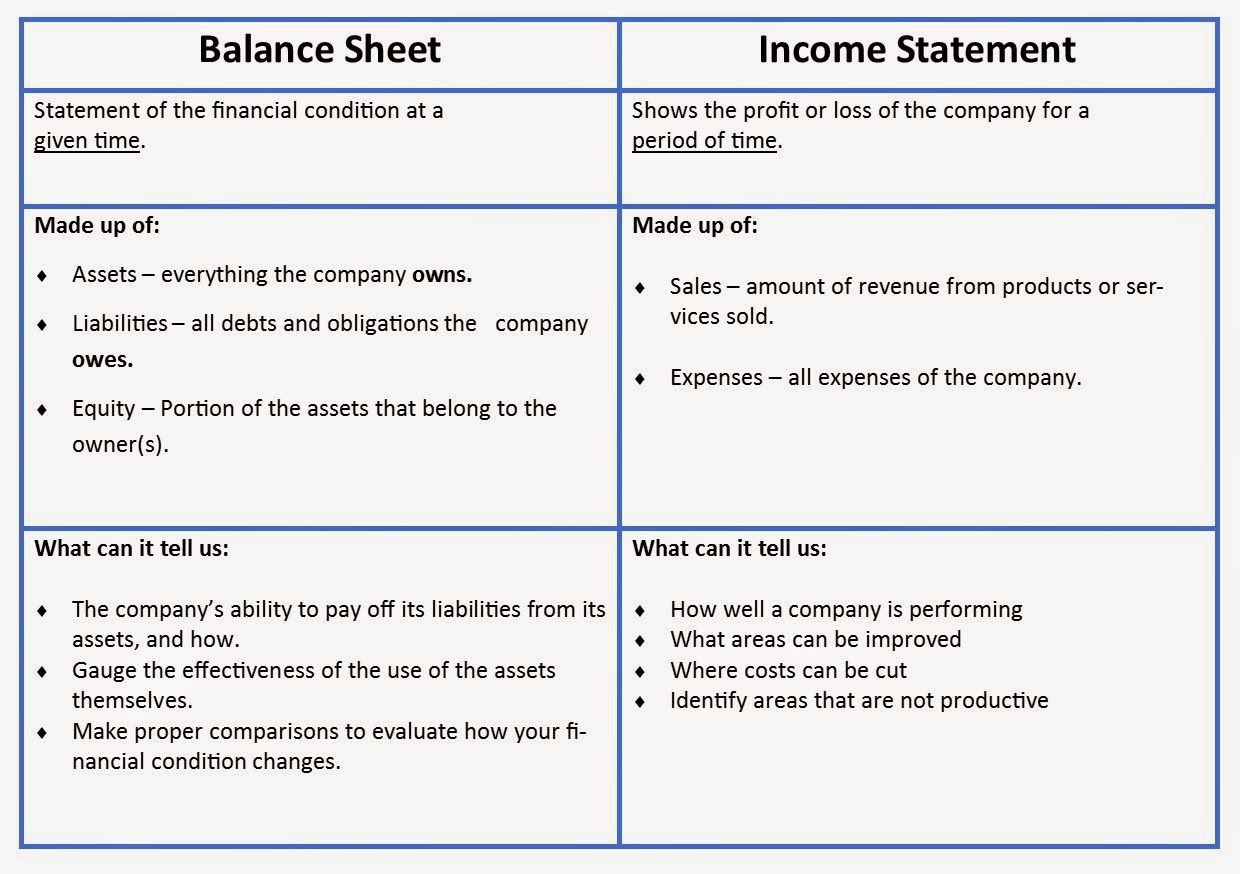

Now, we'll get into more detail about what they can tell us

Take a look at this Balance Sheet
  • The financial reports below are fictitious and do not represent any real company. 

And this Income Statement

Okay, so now what do we know?

Current Ratio = 2.5


This means that this company has enough Current Assets to pay off its Current Liabilities, in full, at least twice. This company has a good current ratio.  
Quick Ratio = 0.63
With this calculation we know that this company could NOT pay off its Current Liabilities using only the current cash and accounts receivables. This company will need to turn other Current Assets into cash before it can pay off all Current Liabilities at the time this report was run. 
Asset to Equity Ratio = 58%
This number tells us that 58% of this companies equity is from the owner, and 42% of the equity is from liabilities (debts). The health value of this number varies by industry, and is most helpful when used to compare to other points in time or to other businesses in the same industry. 

 Productivity Ratio = 18%

This is the rate of return on the total assets, or the return on the overall investment made in the business. This number is most useful when used to compare with previous statements. 
The same formula can also be used to find the effectiveness of each individual asset. 
Operations Ratio = 10%
The rule of the thumb is to have a percentage above 7%. 
This ratio defines a companies profit margin before interest and taxes are taken out. 
Expense Ratio (salaries expense) = 41%
This formula can be used on any expense item. It tells you what percent of sales any expense item is. I chose to demonstrate with the salaries expense and learned that 41% of  sales revenues was used to pay salaries. 
Inventory Turnover = 2 times per year 
This number defines the number of times inventory has been purchased and sold for the time period of this Income Statement. Generally inventory should turn over around 3 times per year at minimum. 
Average Age of Accounts Receivable = 266 Days 
Tells a business how many days, on average, their accounts receivable remains uncollected. Typically the accounts receivable should fall within 30 to 90 days, depending on your companies payment terms. 
As you can see this business should evaluate which customers are typically paying late. 

Do you know this much about your business? You should!


Saturday, January 3, 2015

1099's... What are they? Who Needs Them?

Chances are you will be required to report payments on a 1099-MISC.

What you may not know is the who, what, when, where, and why? 


       The Who and What...

A form 1099-MISC must be given to any person you paid a minimum of $600 to for rent, services, prizes, awards, medical or health care payments, etc. This does not include employees whose reporting's appear on form W-2. 
For example: You pay a cleaning company to perform weekly cleaning task on company property. You must report all payments made to that company, during the given year, on a Form 1099-MISC.  
You must also report the following:
* A minimum of $10 in royalties or broker payments in lieu of dividends or tax-exempt interest.
* Any fishing boat proceeds.
* Gross proceeds of $600 or more paid to an attorney.

The When and Why....

1099-MISC forms must be sent out around the same time you send out W-2 forms. The reason for this is, individuals and companies will need this documentation in order to properly file their Income Tax Returns. You will also need this information for your own tax records. 
It is extremely important to make sure this can properly be done. In order to do that, I would advise you submit, and demand the return of Form W-9, Request for Taxpayer Identification Number, before making any payments.  
Failure to obtain this request may result in you being held liable for applicable taxes. 

The Where...

Form 1099-MISC is structured similar to form W-2. Sections are clearly labeled/numbered, indicating what types of payments should be reported in each box. There is also boxes for any state taxes that may have been withheld. You will want to set up your accounting software to appropriately track these vendors, and amounts. 

For complete instructions please visit IRS.gov.

Thursday, December 4, 2014

Holiday Gifts For Employees

With the holiday season upon us many business owners may be asking

 "What do I need to know about employee gifts?"


Employee gift giving has become a thing to be expected in a lot of businesses today. Employers have come to expect a holiday bonus, or some other personal gift. This expectation has it's benefits of course. Employers who give during the holiday season tend to have employees who work harder, especially during the holiday season. They do this because they feel a sense of appreciation.
That holiday bonus or gift goes a long way for company moral. After all, your employees are the face of your company.
With that said, you have made the business decision to show your appreciation to your employees. So now you are faced with the difficult decision of how exactly you can do that, without hurting yourself.
First, you need to look at your companies financial situation.
  •  This is something you should have been anticipating throughout the year.
  • Also, budgeting for year after year.

Second, ask yourself what is taxable and what is not.... Let me give you an example:
  • You give a turkey to each employee
    • this is NOT a taxable gift
  •  You give a grocery store gift card
    • this IS a taxable gift

Cash or "cash in kind" gifts are typically considered a business expense. Where as an actual "physical item" is typically not.

An important note, rules and restriction can differ based on business entity. I suggest you consult with your tax expert, bookkeeper, or IRS. gov publication 463 for business entity clarification.